--------------------------------------------------------------------------------------------------------------------------------------------------------------------------------------------
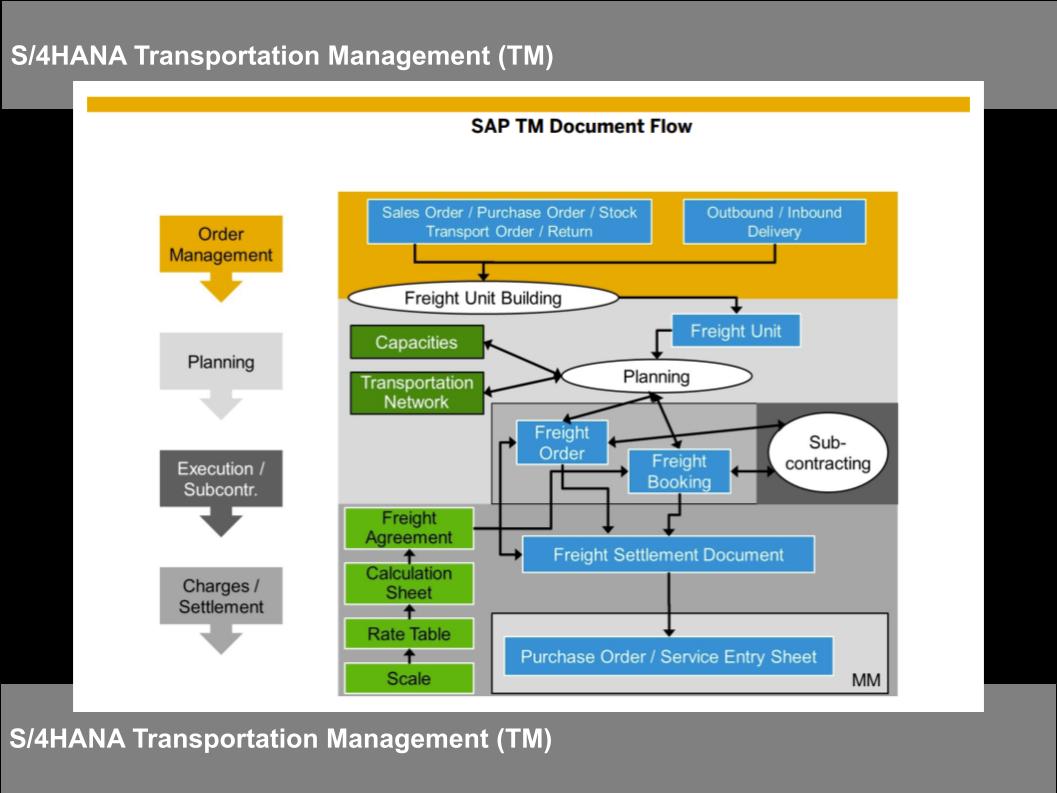
Question: Overview of the Big Picture of S/4HANA Transportation Management.
Answer: S/4HANA TM is planned to replace the LE-TRA (Classic Transportation) module with a dead line of 2017.
click to see an Overview of SAP TM in a nutshell:
https://docs.google.com/BigPicture/--------------------------------------------------------------------------------------------------------------------------------------------------------------------------------------------
Question: What are the methods to Auto generate (Manual or Mass Generate Geocoding data) in APO Locations for Transportation Management in S/4HANA?
Answer: There are few methods of either Manual in /SAPAPO/LOC3, Auto via SA38 with program /SAPAPO/CREATE_LOCATION or Mass creation via transaction /SAPAPO/MASSGEOCODE; see the following Blog Post:
--------------------------------------------------------------------------------------------------------------------------------------------------------------------------------------------
Question: a View of the End-to-End of Outbound with TM processing until Invoice.
Answer: SAP TM supports many transportation scenario:
Road
Air Freight
Rail
Sea Freight
See the following link for Outbound Delivery with TM integration for "Road Transportation":
https://docs.google.com/End-to-End-OutboundwithTM/--------------------------------------------------------------------------------------------------------------------------------------------------------------------------------------------
Question: What is the basic difference between "Ocean Freight" and "Road Freight" TM Processes ?
Answer: "Road Freight" scenario are usually for "Shor Haul" compared to "Ocean Freight" scenario which are considered to be "Long Haul". Therefore, it is logical for "Ocean Freight" TM cases to have additional processes to cater for the management of long haul and Vessel tracking functionalities:
- This include (4) Ocean Freight Booking for Freight Units for booking of Containers and Vessels space with an expected "longer lead time" for Vessel booking and confirmations.
- Additional steps of (5), (6), (7) to confirm the Subcontractor who will manage the pickup of the FU and Delivery to the Port for loading into the Container or Vessel.
- We will expect either the same transporter from Warehouse to Port or different transporter when Vessel arrive to load the FU to the Truck dispatching to the Intermediary or Final destinations.
- Hence, such a process could potentially involve 1 or more 3PL transportation.
click on the following link to SAP documentation:
--------------------------------------------------------------------------------------------------------------------------------------------------------------------------------------------
Question: Outbound Delivery (Delivery-based) integration to TM Freight Unit as below:
The 3 influencing factor that determines the Control Key and Logistics Integration Profile
- Shipping Point (from the Sales/Delivery item).
- Outbound Delivery Type (via the Sales Order Type 1:1 relationship).
- Shipping Condition (Sold-to Party.
The Control Key is then used to activate TM relevancy for which SD or MM trigger point like "Inbound Delivery" or "Outbound Delivery"; it is highly recommended to associate ONE TM relevancy trigger point for each Control Key SO THAT traceability is simplified.
The Logistics Integration Profile provides the following parameters:
- Freight Building Rule.
- Stage Building Rule.
- etc.
See the following overview:
--------------------------------------------------------------------------------------------------------------------------------------------------------------------------------------------
Question: Review the relationships of the HR Organization Units and MM Organization Units
Answer: Mapping HR Org Unit to MM Purchasing Group and Purchasing Organization is an essential step to default the Purchasing Group & Purchasing Org to the FU or FO so that there can be used as default data to create the Purchase Order at time of Freight Settlement Document (FSD) Posting.
See the following SAP demo:
--------------------------------------------------------------------------------------------------------------------------------------------------------------------------------------------
Question: Is the Route still applicable in S/4HANA SD when TM no longer use the LE-Route but uses the TM-Route ?
Answer: Highly recommend to keep the LE-Route configurations to get the desired Lead Time Scheduling for Schedule Lines to the Sales Order confirmation date backward or forward scheduling.
--------------------------------------------------------------------------------------------------------------------------------------------------------------------------------------------
Question: What is the difference between Classic Transpiration (from ECC LE-TRA) vs S/4HANA TM Basics and S/4HANA Advanced TM ?
Answer: It is important to understand that there are "MINOR" differences between the classic LE-TRA vs the TM Basic except for LBN (Logistics Business Network) and ASN (Advanced Shipment Notification).
Key differences:
- S/4HANA TM Basics offers LESS Transpiration scenarios compared to Advanced TM.
- GIS feature for management transportation processing is only offered via Advanced TM.
- You can also expect the Advanced Optimization tools are only available in Advanced TM.
- Interesting that SAP only offers TM Analytics when the customer decided to use Advanced TM.
- Freight forwarders act as an intermediary between the company who makes the shipment and the final destination for the goods that this scenario is only offered via the Advanced TM.
Do check the the Country where the Basic and Advanced TM is offered to understand the licensing requirements as some of them may be Century specific.
See sap links below:
--------------------------------------------------------------------------------------------------------------------------------------------------------------------------------------------


.jpg)
.jpg)

.jpg)
.jpg)
.jpg)

No comments:
Post a Comment
Note: Only a member of this blog may post a comment.